OUR TECHNOLOGY
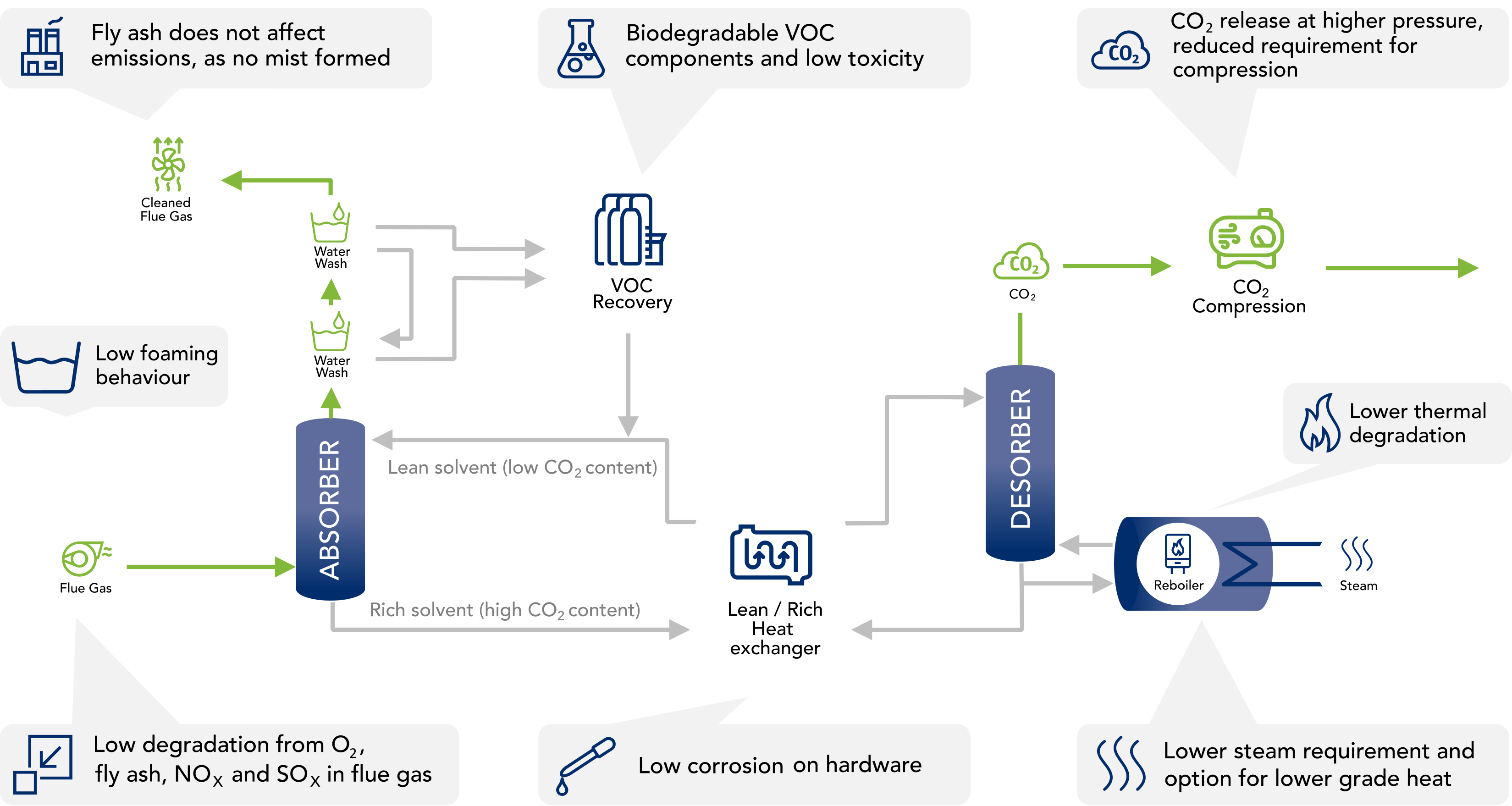
HOW THE TECHNOLOGY WORKS
C‑Capture’s technology is based on post‑combustion CO₂ capture using a novel, non‑amine liquid solvent system, deployed in a conventional absorption–regeneration flowsheet but enabled by a fundamentally different capture chemistry. The process has been deliberately engineered to retain the operational familiarity of solvent‑based carbon capture while eliminating many of the limitations associated with amine systems.
Absorption


Flue gas is contacted with a lean solvent in a packed or tray absorber. CO₂ is selectively absorbed into the solvent via a reversible chemical mechanism that does not rely on amine carbamate formation. The solvent formulation comprises a capture agent derived from a benign organic acid salt, combined with a tailored reactivity moderator, which creates the chemical environment required for rapid CO₂ uptake while suppressing undesirable side reactions.
The solvent exhibits high tolerance to typical industrial contaminants such as SOx, NOx, oxygen, particulates, and trace metals. This robustness minimises solvent degradation and fouling, reducing the need for extensive upstream gas polishing and allowing stable operation across a wide range of flue‑gas compositions and load conditions.
Solvent Stability and Cycling

The solvent is designed to tolerate repeated thermal cycling between absorber and desorber with low degradation rates. Unlike amine systems, which form heat‑stable salts and toxic degradation products, the C‑Capture solvent degrades into environmentally benign species, with no formation of nitrosamines or other hazardous compounds.
Solvent losses from oxidative, thermal, or contaminant‑driven pathways are therefore low, and solvent management is simplified. This has been demonstrated through long‑duration operation on CCSCUs, the fully integrated pilot plant, and real flue‑gas exposure.
Regeneration (CO₂ Release)

CO₂‑rich solvent exiting the absorber is transferred to a desorber (stripper), where heat is applied to reverse the capture reaction and release CO₂. A key advantage of the C‑Capture chemistry is that CO₂ is released at lower regeneration energy compared with conventional amine systems, driven by a reduced enthalpy of reaction and favourable equilibrium behaviour.
The regeneration step operates at lower reboiler duty, reducing steam demand and parasitic energy load. In addition, CO₂ is liberated at elevated pressure relative to amine systems, which reduces downstream compression requirements and balance‑of‑plant energy consumption.
System Integration and Operability

From a process‑engineering perspective, the technology is implemented as a fully integrated closed solvent loop, comprising absorption, regeneration, heat integration, solvent recycles, and CO₂ drying/compression interfaces. The system behaves predictably during start‑up, shut‑down, load changes, and upset conditions, enabling industrial‑grade operability rather than laboratory‑scale behaviour.
Crucially, the pilot and CCSCU deployments are based on scaled‑down commercial engineering design, not scaled‑up lab equipment. This has allowed early development of control strategies, materials selection, corrosion management, and operating procedures consistent with full‑scale deployment.
WHY THE CHEMISTRY MATTERS
The core technical advantage lies not in reinventing the flowsheet, but in engineering a solvent chemistry that removes the intrinsic weaknesses of amines. By decoupling CO₂ capture performance from high regeneration energy, solvent instability, and environmental risk, C‑Capture enables:
- Lower cost of capture driven primarily by reduced energy demand
- Stable long‑term operation in harsh industrial environments
- Simplified permitting and waste handling
- Direct scalability to commercial units without fundamental process change
The result is a carbon capture process that combines familiar unit operations with fundamentally improved solvent behaviour, making it both technically robust and commercially deployable.